Time has never been just a number for the Jewish people — it’s a covenant. The way Jews measure days, months, and years has been shaped by thousands of years of theology, astronomy, exile, and survival. Jewish calendar development is not a single moment of invention but a long, layered journey from ancient agricultural rhythms to a sophisticated lunisolar system that still governs the rhythm of Jewish life around the world today.
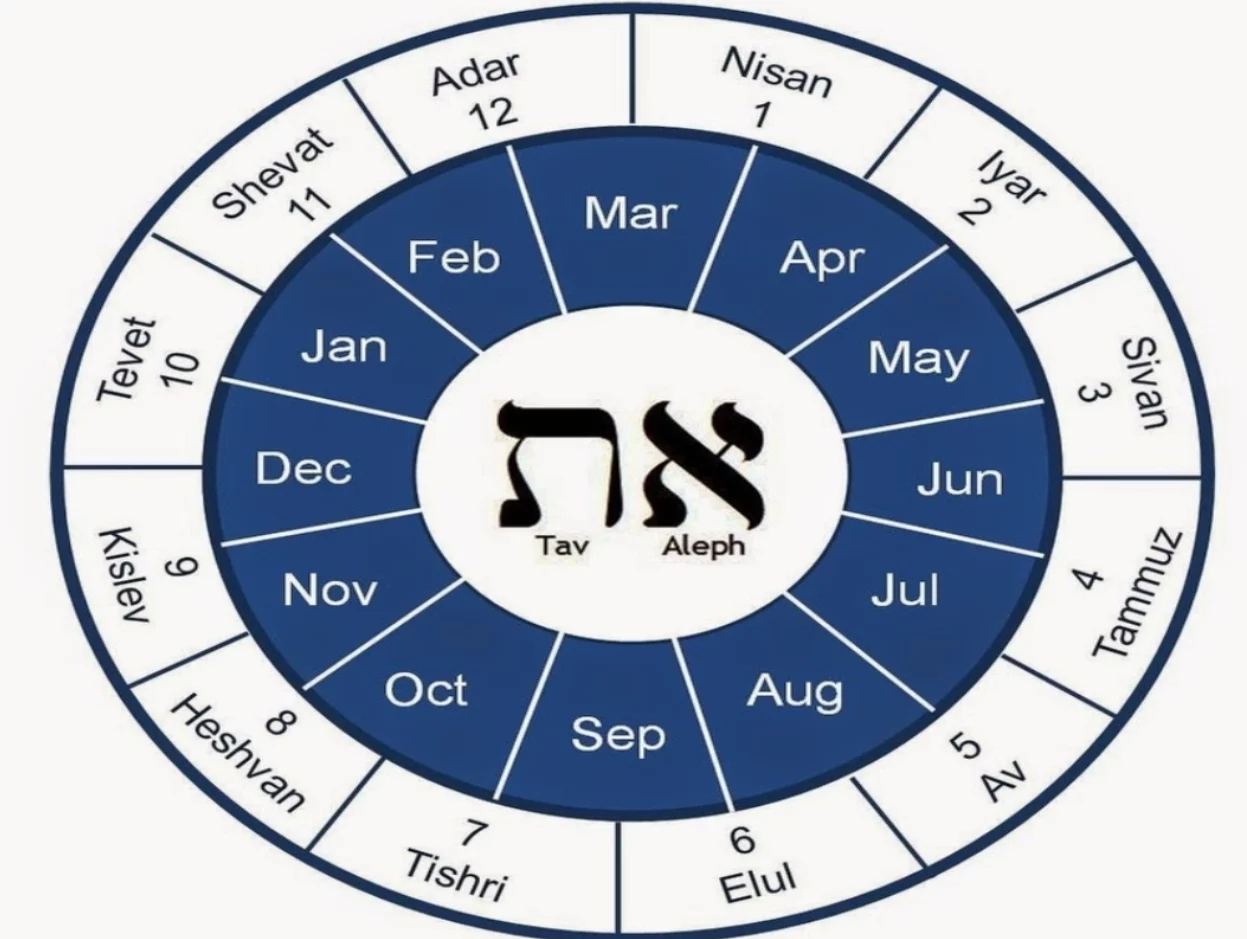
Understanding this calendar means understanding something essential about Jewish identity itself: that time is sacred, that history repeats in cycles, and that every year brings the community back to the same holy moments — no matter where in the world they happen to be.
Biblical Roots: Time Before the System
The earliest traces of the Jewish calendar appear in the Hebrew Bible itself. In those ancient texts, months were simply numbered — “the first month,” “the seventh month” — rather than given formal names. The calendar in the Hebrew Bible was deeply tied to agriculture and religious ritual, governing when to plant, when to harvest, and when to bring offerings to God.
The month of Abib, for example — later known as Nisan — is mentioned in the Book of Exodus as the month of the Passover, when the Israelites fled Egypt. This month was explicitly declared the “first month” of the religious year, making it the anchor of the entire biblical calendar. The number seven held special significance: the seventh day was the Sabbath, the seventh month was packed with holy days, and every seventh year was the Shemitah — a year of rest for the land.
At this stage, the calendar was largely observational. New months began when priests or community elders confirmed the sighting of the new crescent moon. There was no fixed mathematical formula — just human eyes watching the sky and religious authorities making declarations.
The Babylonian Exile: A Calendar Transformed
A decisive turning point in Jewish calendar development came during the Babylonian Exile in the 6th century BCE, when the kingdom of Judah was conquered and thousands of Jews were taken to Babylon. Living in the heart of one of the ancient world’s greatest astronomical civilizations, Jewish scholars absorbed Babylonian knowledge of the stars, planets, and lunar cycles.
The month names that Jews use today — Tishrei, Nisan, Iyar, Tammuz, Kislev, and the rest — are not Hebrew in origin. They are Babylonian names that were adopted during this period of exile and retained permanently after Jews returned to their homeland. The Books of Esther and Nehemiah, which describe events after the exile, already use these Babylonian-influenced names as if they were entirely natural.
This cultural exchange was not seen as a betrayal of tradition. Rather, it was a practical adaptation that allowed the Jewish calendar to absorb more precise astronomical thinking while preserving its religious framework. The lunisolar structure — tracking both the moon for months and the sun for years — became more firmly established during this era.
The Second Temple Period: Authority and Calculation
During the Second Temple period (roughly 516 BCE to 70 CE), the Jewish calendar was administered by the Sanhedrin — the supreme council of Jewish law based in Jerusalem. Each month still began based on eyewitness testimony of the new moon. Witnesses who had seen the crescent moon would report to the Sanhedrin, which would officially declare the new month and send word to Jewish communities near and far.
This system worked reasonably well as long as the Jewish community was centered in Israel. But as Jewish populations spread across the Roman world, sending timely word about the new month became increasingly difficult. Far-flung communities could go weeks without knowing exactly when the month had begun — and therefore when to celebrate holidays like Passover or Yom Kippur.
The destruction of the Second Temple in 70 CE by the Romans shattered the institutional framework that held this system together. The Sanhedrin lost its seat in Jerusalem and was eventually forced to relocate. A new approach to timekeeping would soon become necessary.
Hillel II and the Fixed Calendar (359 CE)
The most important single event in the formal development of the Jewish calendar is credited to Hillel II, a Palestinian patriarch, who around 359 CE introduced a fixed mathematical calendar to replace the observation-based system. According to historical accounts, this change was driven by two forces: the persecution of Jewish leaders under the Roman emperor Constantius II, which made it dangerous to continue holding open councils, and growing advances in astronomical science that made precise calculation possible without needing to watch the actual sky.
Hillel II’s fixed calendar established clear, repeatable mathematical rules for every aspect of Jewish timekeeping. It codified the 19-year Metonic cycle — a system by which 7 leap years (with an extra 13th month called Adar II) are inserted over every 19-year period. This keeps the lunar months from drifting too far out of alignment with the solar year, ensuring that spring festivals like Passover always fall in spring, and autumn holidays like Rosh Hashanah always arrive in early fall.
This was a monumental shift. For the first time in Jewish history, any rabbi anywhere in the world could calculate the exact dates of every holiday for centuries into the future — no moon-watching required. The calendar became an engine of Jewish unity across the diaspora.
Structure of the Modern Jewish Calendar
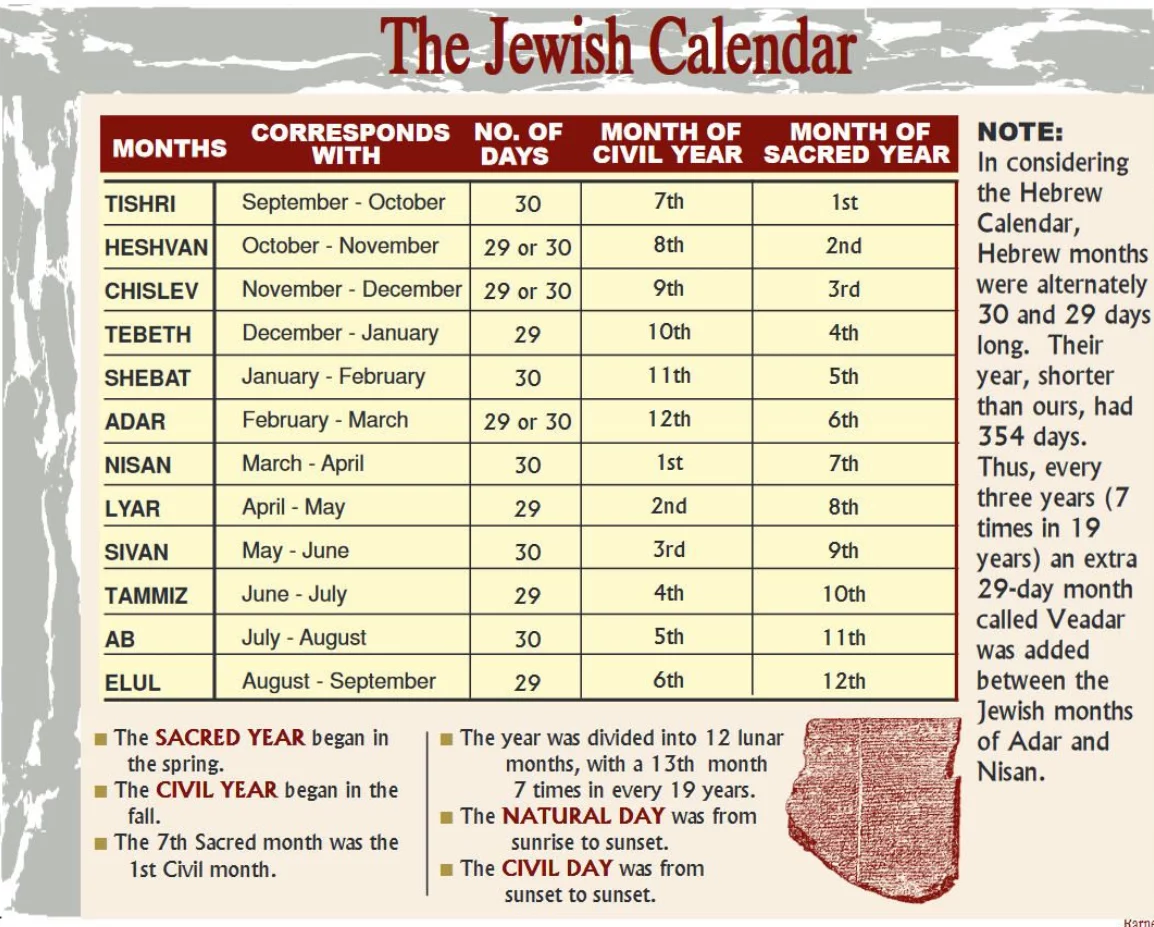
The Jewish calendar as it exists today is a lunisolar calendar with 12 months in regular years and 13 months in leap years. A standard year has either 353, 354, or 355 days, while a leap year has 383, 384, or 385 days. The variation exists because the calendar includes deliberate adjustments — called dechiyot — to ensure certain holidays never fall on specific days of the week that would create religious complications.
The 12 regular months and their approximate Gregorian equivalents are:
- Tishrei — September–October (Rosh Hashanah, Yom Kippur, Sukkot)
- Heshvan — October–November
- Kislev — November–December (Hanukkah)
- Tevet — December–January
- Shevat — January–February (Tu B’Shevat)
- Adar — February–March (Purim)
- Nisan — March–April (Passover)
- Iyar — April–May (Lag B’Omer)
- Sivan — May–June (Shavuot)
- Tammuz — June–July
- Av — July–August (Tisha B’Av)
- Elul — August–September (preparation for High Holy Days)
In a leap year, an extra month — Adar I — is inserted before the regular Adar, which becomes Adar II. This is the Jewish calendar’s elegant solution to the 11-day gap between the lunar and solar year.
Anno Mundi: Counting Years From Creation
The Jewish calendar counts years from what rabbinic tradition calculates as the date of creation — a system known as Anno Mundi (Latin for “year of the world”). Based on calculations by medieval scholars, the year of creation is reckoned as 3761 BCE in the Gregorian system. This means that the Jewish year 5786 corresponds roughly to the Gregorian year 2026. The Jewish New Year — Rosh Hashanah — marks not only the start of a new calendar year but the anniversary of the creation of humanity itself, giving the date profound theological weight.
Modern Jewish Observances Shaped by the Calendar
The Jewish calendar is not just a scheduling tool — it is the skeleton of Jewish religious life. Every week ends with Shabbat, the Sabbath, which begins Friday at sunset and ends Saturday night. The High Holy Days of Rosh Hashanah and Yom Kippur in Tishrei are the most solemn and widely observed events of the year. Passover in Nisan commemorates the Exodus from Egypt with the Seder meal. Shavuot in Sivan marks the giving of the Torah at Mount Sinai.
Even in a secular modern world, the Jewish calendar continues to structure the lives of Jewish communities across Israel, the United States, Europe, and beyond. Many non-religious Jews who rarely attend synagogue still observe Passover, light Hanukkah candles, or fast on Yom Kippur — proof that the calendar’s grip on Jewish identity runs deeper than formal religion.
A Living System Across 3,000 Years
What makes Jewish calendar development so remarkable is not just its age — it’s its adaptability. From simple moon-watching in ancient Israel, to Babylonian month names absorbed in exile, to the mathematical genius of Hillel II’s fixed system, the Jewish calendar has bent with history without ever breaking. It has united scattered communities across continents and centuries, providing a shared rhythm of time that transcends geography.
Today, the same dates that guided farmers in ancient Canaan tell a Jewish family in New York, Tel Aviv, or Melbourne exactly when to gather at the table, light candles, sound the shofar, or begin a fast. That continuity — unbroken across more than three millennia — is one of the most extraordinary feats in the history of human civilization.