Time is something most people take for granted. Every day, billions of people rely on calendars to schedule work, celebrate holidays, and organize their lives. Yet few realize that the modern calendar owes much of its structure to the political decisions of ancient Roman emperors. Among them, Augustus Caesar played a crucial role in refining one of history’s most important calendar reforms.
The story of Augustus Caesar and calendar reform reveals how rulers used their power to influence not only politics and society but also the very way people measured time. His contributions helped shape the calendar system that eventually evolved into the one used throughout much of the world today.
The Roman Calendar Before Augustus
Before understanding Augustus’s role, it is important to look at the calendar system he inherited.
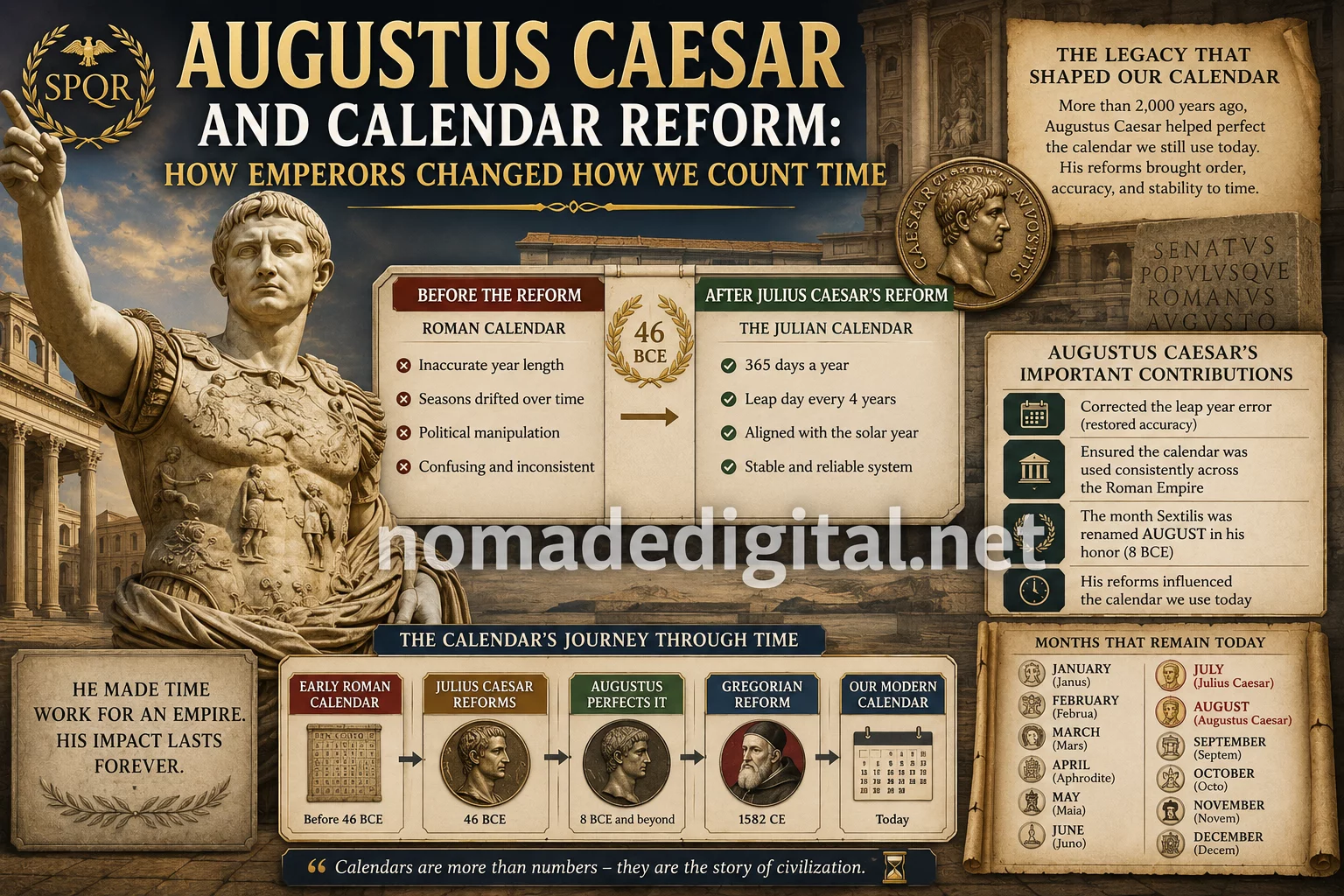
Early Romans used a calendar that was often confusing and inconsistent. The original Roman calendar is believed to have contained only ten months and roughly 304 days. Over time, additional months were added, but the system remained inaccurate.
The calendar relied heavily on political and religious officials to insert extra days or months when needed. This process often became influenced by politics.
Problems included:
- Inconsistent year lengths
- Seasonal drift
- Political manipulation
- Administrative confusion
By the first century BCE, the Roman calendar no longer aligned properly with the solar year.
Julius Caesar’s Revolutionary Calendar Reform
The major transformation began with Augustus’s adoptive father, Julius Caesar.
After consulting Egyptian astronomers, particularly those familiar with solar timekeeping, Julius Caesar introduced the Julian Calendar in 46 BCE.
Key features included:
- A 365-day year
- An extra leap day every four years
- Improved alignment with the solar year
The reform created a much more reliable system for agriculture, government, and commerce.
Because of its significance, historians often consider the Julian Calendar one of the most important administrative reforms in human history.
The Year of Confusion
Implementing the Julian Calendar required a major adjustment.
To realign the calendar with the seasons, the year 46 BCE was extended to approximately 445 days.
This unusual year became known as the “Year of Confusion.”
Although disruptive, the correction successfully synchronized the Roman calendar with the solar year.
The foundation for modern timekeeping had been established.
Augustus Caesar Inherits the Calendar
After Julius Caesar’s assassination in 44 BCE, his adopted heir Octavian eventually became Emperor Augustus.
As Rome’s first emperor, Augustus inherited both the benefits and challenges of the Julian Calendar.
One unexpected problem emerged shortly after the reform.
Roman officials misunderstood the leap-year instructions and began inserting leap days too frequently.
Instead of adding a leap day every four years, they added one every three years.
This seemingly minor error gradually created inaccuracies.
Augustus Corrects the Leap Year Mistake
Recognizing the problem, Augustus intervened.
He ordered the suspension of leap years for a period of time to restore proper alignment.
This correction ensured that the calendar followed Julius Caesar’s original design.
Without Augustus’s intervention, the Julian Calendar might have accumulated significant errors much earlier.
His action demonstrated how important accurate timekeeping had become for governing the Roman Empire.
The Creation of August
One of Augustus’s most famous contributions to the calendar involved the month now known as August.
Originally, this month was called Sextilis, meaning “sixth month” in the older Roman system.
In 8 BCE, the Roman Senate renamed Sextilis in honor of Augustus.
Several significant events in Augustus’s career had occurred during this month, including military victories and political achievements.
As a result:
- Quintilis became July (honoring Julius Caesar)
- Sextilis became August (honoring Augustus Caesar)
These names remain part of the modern calendar more than 2,000 years later.
The Myth of August’s Length
A popular story claims Augustus added an extra day to August so his month would be as long as July.
According to the legend, a day was supposedly taken from February to achieve this balance.
However, modern historians generally reject this claim.
Evidence suggests that the month lengths had already been established under the Julian reform before Augustus renamed Sextilis.
Despite being a myth, the story demonstrates the lasting connection between emperors and calendar history.
Why Calendar Reform Mattered to the Roman Empire
A standardized calendar provided enormous advantages.
Agricultural Planning
Farmers relied on predictable seasons for planting and harvesting.
Tax Collection
Government officials could organize revenue systems more effectively.
Military Operations
Campaigns and troop movements required accurate scheduling.
Religious Festivals
Important ceremonies could be observed consistently.
Trade and Commerce
Merchants benefited from reliable dates and contracts.
For a vast empire spanning three continents, calendar consistency was essential.
The Political Power of Time
Calendar reform was not merely a technical matter.
Control over timekeeping also represented political authority.
By regulating calendars, rulers could:
- Demonstrate power
- Promote stability
- Standardize administration
- Strengthen legitimacy
The naming of months after Julius Caesar and Augustus illustrates how leaders used calendars to reinforce their legacy.
Every time someone says “July” or “August,” they unknowingly reference two of Rome’s most influential figures.
The Legacy of the Julian Calendar
The Julian Calendar remained dominant for more than 1,600 years.
It spread through:
- The Roman Empire
- Medieval Europe
- Christian religious institutions
Although highly accurate, the Julian system slightly overestimated the length of the solar year.
The difference amounted to approximately 11 minutes per year.
Over centuries, this small discrepancy accumulated into several days.
The Gregorian Reform and Augustus’s Influence
In 1582, Pope Gregory XIII introduced the Gregorian Calendar to correct errors that had accumulated under the Julian system.
The Gregorian Calendar remains the international standard today.
Despite modifications, it retains many features inherited from the Julian Calendar.
These include:
- Twelve months
- Similar month lengths
- Leap year principles
- Month names such as July and August
In this way, Augustus’s influence continues to shape modern life.
How Augustus Changed Modern Timekeeping
Although Julius Caesar initiated the major reform, Augustus ensured its long-term success.
His contributions included:
- Correcting leap-year implementation
- Stabilizing the calendar
- Supporting administrative consistency
- Cementing the calendar’s political importance
Without these adjustments, the Julian Calendar might not have functioned as effectively as it did.
Fascinating Facts About Augustus and Calendar Reform
- Augustus ruled from 27 BCE to 14 CE.
- August is named after Augustus Caesar.
- He corrected leap-year calculation errors.
- The Julian Calendar remained in use for over 16 centuries.
- July and August both honor Roman leaders.
- Modern calendars still reflect Roman timekeeping traditions.
Frequently Asked Questions
Who created the Julian Calendar?
Julius Caesar introduced the Julian Calendar in 46 BCE with assistance from Egyptian astronomers.
What role did Augustus Caesar play in calendar reform?
Augustus corrected leap-year errors and helped ensure the calendar’s long-term accuracy.
Why is August named August?
The Roman Senate renamed the month Sextilis in honor of Emperor Augustus in 8 BCE.
Did Augustus add a day to August?
Most historians consider this a myth. Month lengths were likely established before the renaming.
How did Roman calendar reforms affect modern calendars?
Many features of today’s calendar, including month names and leap-year concepts, originated from Roman reforms.
Is the Gregorian Calendar based on the Julian Calendar?
Yes. The Gregorian Calendar refined and improved the Julian system while retaining many of its core elements.
The story of Augustus Caesar and Calendar Reform: How Emperors Changed How We Count Time highlights the remarkable influence ancient rulers had on everyday life. While Julius Caesar introduced the revolutionary Julian Calendar, Augustus played a critical role in correcting errors, maintaining accuracy, and ensuring the system’s success throughout the Roman Empire.
More than two millennia later, the legacy of these reforms remains visible in the calendars we use every day. Every glance at the month of August serves as a reminder that the way we measure time today was shaped not only by astronomy and mathematics but also by the ambitions and decisions of history’s most powerful emperors.