The ancient Maya are renowned for their remarkable achievements in astronomy, mathematics, architecture, and timekeeping. Among their most fascinating innovations was the Mayan Calendar Round, a sophisticated system that combined two separate calendars into a repeating cycle lasting approximately 52 years.
Unlike modern calendars that simply count days and years, the Maya viewed time as a sacred and interconnected force. Their Calendar Round allowed them to track ceremonies, agricultural activities, religious events, and historical milestones with extraordinary precision.
Today, historians and archaeologists continue to study the Mayan Calendar Round because it reveals the advanced knowledge and cultural beliefs of one of the world’s most impressive ancient civilizations.
What Is the Mayan Calendar Round?
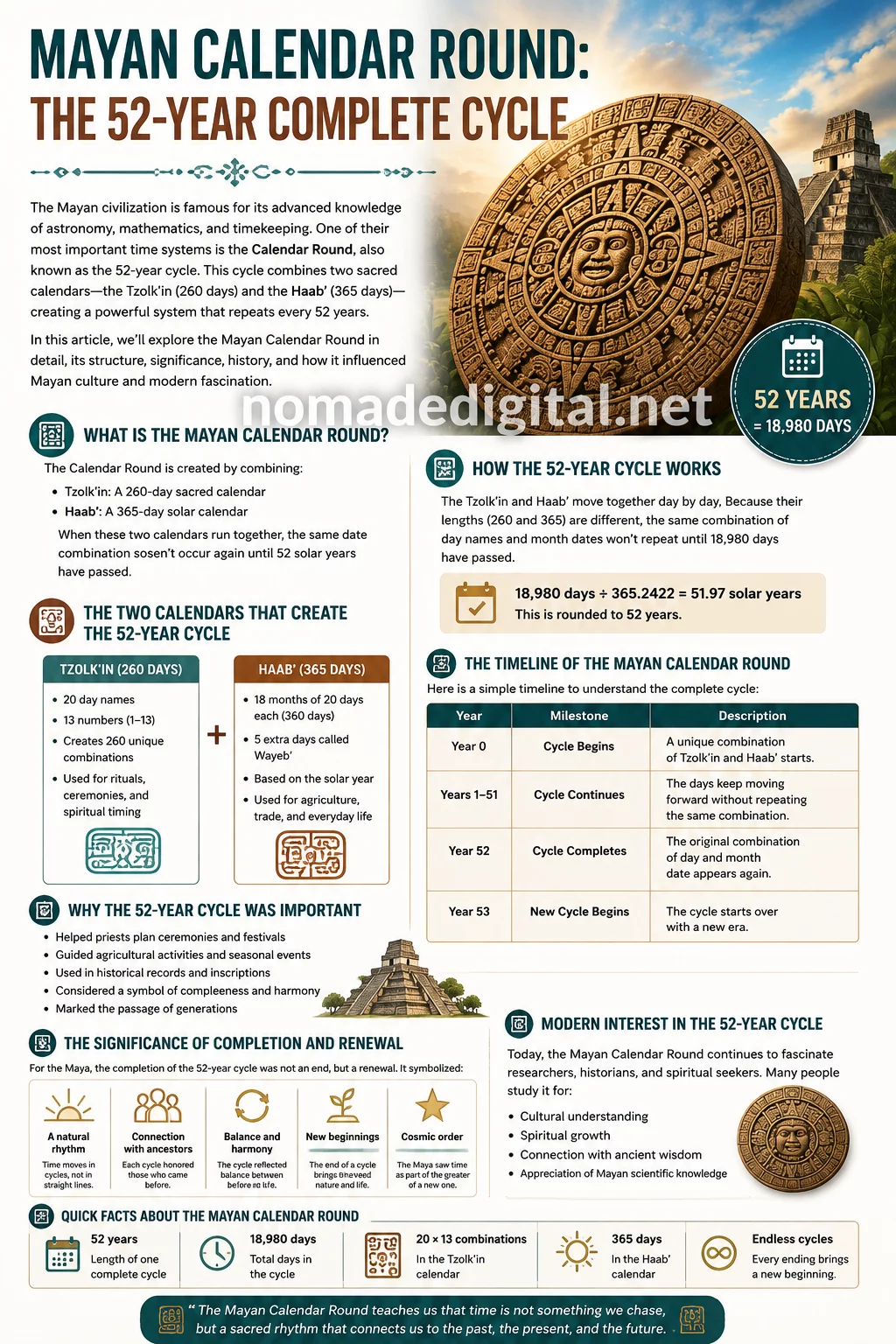
The Mayan Calendar Round is a calendar system created by combining two different calendars:
- The Tzolk’in (260-day sacred calendar)
- The Haab’ (365-day solar calendar)
Each day was identified by a unique combination of dates from both calendars.
Because the two calendars operate on different cycles, the same date combination does not repeat until 18,980 days have passed. This period equals approximately 52 solar years, creating what scholars call the Calendar Round.
For the Maya, this 52-year cycle represented a complete period of time and held deep spiritual significance.
Understanding the Tzolk’in Calendar
The Tzolk’in was the Maya’s sacred calendar.
It consisted of:
- 20 day names
- 13 numerical values
These numbers and names rotated continuously to create 260 unique day combinations.
Examples of Tzolk’in dates include:
- 1 Imix
- 2 Ik’
- 3 Ak’bal
The Tzolk’in was primarily used for:
- Religious ceremonies
- Divination
- Spiritual guidance
- Naming rituals
- Sacred events
Mayan priests carefully followed the Tzolk’in to determine auspicious days for important activities.
Understanding the Haab’ Calendar
The Haab’ served as the Maya’s solar calendar.
It consisted of:
- 18 months
- 20 days per month
This accounted for 360 days.
An additional five-day period called Wayeb’ was added to complete the 365-day year.
The Haab’ was used for:
- Agriculture
- Seasonal planning
- Trade activities
- Civic administration
- Daily life
Unlike the sacred Tzolk’in, the Haab’ focused on practical aspects of society and the natural world.
How the Calendar Round Worked
The Calendar Round functioned by pairing one Tzolk’in date with one Haab’ date.
For example:
4 Ahau 8 Kumk’u
This combination would occur only once during the entire 52-year cycle.
As both calendars advanced independently, new date combinations were constantly created.
Because the 260-day and 365-day cycles have different lengths, they do not align again until 18,980 days have passed.
Mathematically:
260 × 73 = 18,980
365 × 52 = 18,980
This mathematical relationship forms the basis of the Calendar Round.
Why the Number 52 Was Important
The completion of a 52-year cycle held tremendous significance for many Mesoamerican cultures.
For the Maya, the Calendar Round symbolized:
- Renewal
- Completion
- Cosmic balance
- Spiritual transformation
- The continuation of life
Many ceremonies marked the conclusion of a Calendar Round and celebrated the beginning of a new cycle.
The number 52 became associated with continuity and the enduring rhythm of the universe.
The Calendar Round and Mayan Society
Timekeeping was central to Mayan culture.
The Calendar Round influenced nearly every aspect of life.
Religious Ceremonies
Priests used calendar dates to determine when rituals should occur.
Agriculture
Farmers relied on calendar observations to plan planting and harvesting.
Politics
Rulers often linked important events to specific calendar dates.
Historical Records
Monuments and inscriptions frequently included Calendar Round dates.
By integrating sacred and practical timekeeping, the Maya created a system that connected everyday life with spiritual beliefs.
Limitations of the Calendar Round
Although highly effective, the Calendar Round had one limitation.
Because dates repeated every 52 years, it could not uniquely identify events separated by more than one cycle.
For example, a date occurring in one cycle would reappear 52 years later.
This created challenges when recording long-term historical events.
To solve this problem, the Maya developed another system known as the Long Count Calendar.
The Relationship Between the Calendar Round and the Long Count
The Long Count Calendar extended beyond the 52-year cycle.
While the Calendar Round identified recurring dates, the Long Count counted days continuously from a fixed starting point.
This allowed the Maya to:
- Record historical events accurately
- Track long periods of time
- Document dynastic histories
- Preserve chronological records
Together, the Calendar Round and Long Count formed one of the most sophisticated timekeeping systems in the ancient world.
Astronomy and the Calendar Round
Mayan calendar systems were closely connected to astronomical observations.
Mayan astronomers carefully studied:
- The sun
- The moon
- Venus
- Eclipses
- Seasonal cycles
Their observations helped improve calendar accuracy and strengthen the connection between celestial events and religious practices.
Many scholars consider Mayan astronomy among the most advanced in the ancient Americas.
Spiritual Meaning of the 52-Year Cycle
For the Maya, time was not simply a measurement.
It was a sacred force that moved in repeating cycles.
The completion of a Calendar Round symbolized:
Renewal
The end of one cycle and the beginning of another.
Cosmic Order
The universe remained balanced through repeating patterns.
Connection to Ancestors
Each cycle linked generations across time.
Sacred Continuity
Life continued through recurring rhythms rather than linear progression.
These beliefs shaped Mayan religion and worldview.
Comparison With Modern Calendars
Modern calendars generally follow a linear model.
Years progress continuously from one date to the next.
The Mayan Calendar Round differed significantly.
Modern Calendar
- Linear progression
- Focus on chronological years
- Civil and administrative purposes
Calendar Round
- Cyclical structure
- Spiritual significance
- Combined sacred and solar timekeeping
This difference highlights how cultures can view and organize time in unique ways.
Modern Interest in the Mayan Calendar Round
The Calendar Round continues to fascinate people today.
Researchers study it to better understand:
- Ancient mathematics
- Astronomy
- Religion
- Archaeology
- Indigenous knowledge systems
Many modern Maya communities continue to honor traditional calendar practices.
The Calendar Round remains an important symbol of cultural heritage and historical achievement.
Fascinating Facts About the Calendar Round
- The complete cycle lasts 18,980 days.
- It combines a 260-day sacred calendar with a 365-day solar calendar.
- The cycle repeats every 52 years.
- It was used throughout much of Mesoamerica.
- It influenced religious and agricultural activities.
- It worked alongside the Long Count Calendar.
- It reflects advanced mathematical understanding.
Frequently Asked Questions
What is the Mayan Calendar Round?
The Calendar Round is a 52-year cycle created by combining the 260-day Tzolk’in calendar and the 365-day Haab’ calendar.
How long is the Calendar Round?
The complete cycle lasts 18,980 days, or approximately 52 solar years.
Why was the Calendar Round important?
It helped the Maya organize religious ceremonies, agricultural activities, and historical events.
What calendars make up the Calendar Round?
The Tzolk’in sacred calendar and the Haab’ solar calendar.
Did the Calendar Round predict the end of the world?
No. The Calendar Round was a cyclical timekeeping system and had no connection to end-of-the-world predictions.
Is the Calendar Round still used today?
Some modern Maya communities continue to preserve traditional calendar knowledge and practices.
The Mayan Calendar Round: The 52-Year Complete Cycle stands as one of humanity’s most remarkable achievements in timekeeping. By combining the sacred Tzolk’in calendar with the solar Haab’ calendar, the Maya created a sophisticated system that tracked time through repeating cycles of spiritual and practical significance.
Far more than a simple calendar, the Calendar Round reflected the Maya’s understanding of mathematics, astronomy, religion, and the natural world. Its 52-year cycle symbolized renewal, balance, and continuity, demonstrating how deeply interconnected time was with every aspect of Mayan life. Even today, the Calendar Round remains a powerful testament to the ingenuity and cultural legacy of the ancient Maya.