Today, the Gregorian calendar is the world’s most widely used civil calendar. It governs international business, government operations, education systems, and everyday life for billions of people. Yet its journey to global acceptance was neither quick nor simple.
The adoption of the Gregorian calendar took place over more than 300 years, with countries embracing the reform at different times based on religion, politics, science, and cultural traditions. Some nations adopted it almost immediately after its introduction, while others resisted for centuries.
This complete timeline explores how different countries adopted the Gregorian calendar and how this calendar reform transformed global timekeeping.
What Is the Gregorian Calendar?
The Gregorian calendar was introduced by Pope Gregory XIII in 1582 to correct inaccuracies in the Julian calendar.
The Julian calendar, established by Julius Caesar in 45 BCE, assumed that a solar year lasted exactly 365.25 days. In reality, the Earth’s orbit around the sun takes approximately 365.2422 days.
Although the difference seems small, it accumulated over centuries, causing important dates such as the spring equinox to drift away from their intended positions.
To solve this problem, Pope Gregory XIII introduced a revised calendar system with improved leap year rules.
Why Calendar Reform Was Necessary
By the sixteenth century, the Julian calendar was approximately ten days behind the solar year.
This discrepancy created challenges for:
- Religious observances
- Agricultural planning
- Astronomical calculations
- Seasonal celebrations
The Catholic Church sought to restore the proper timing of Easter and other religious holidays, leading to the development of the Gregorian calendar.
1582: The First Countries Adopt the Gregorian Calendar
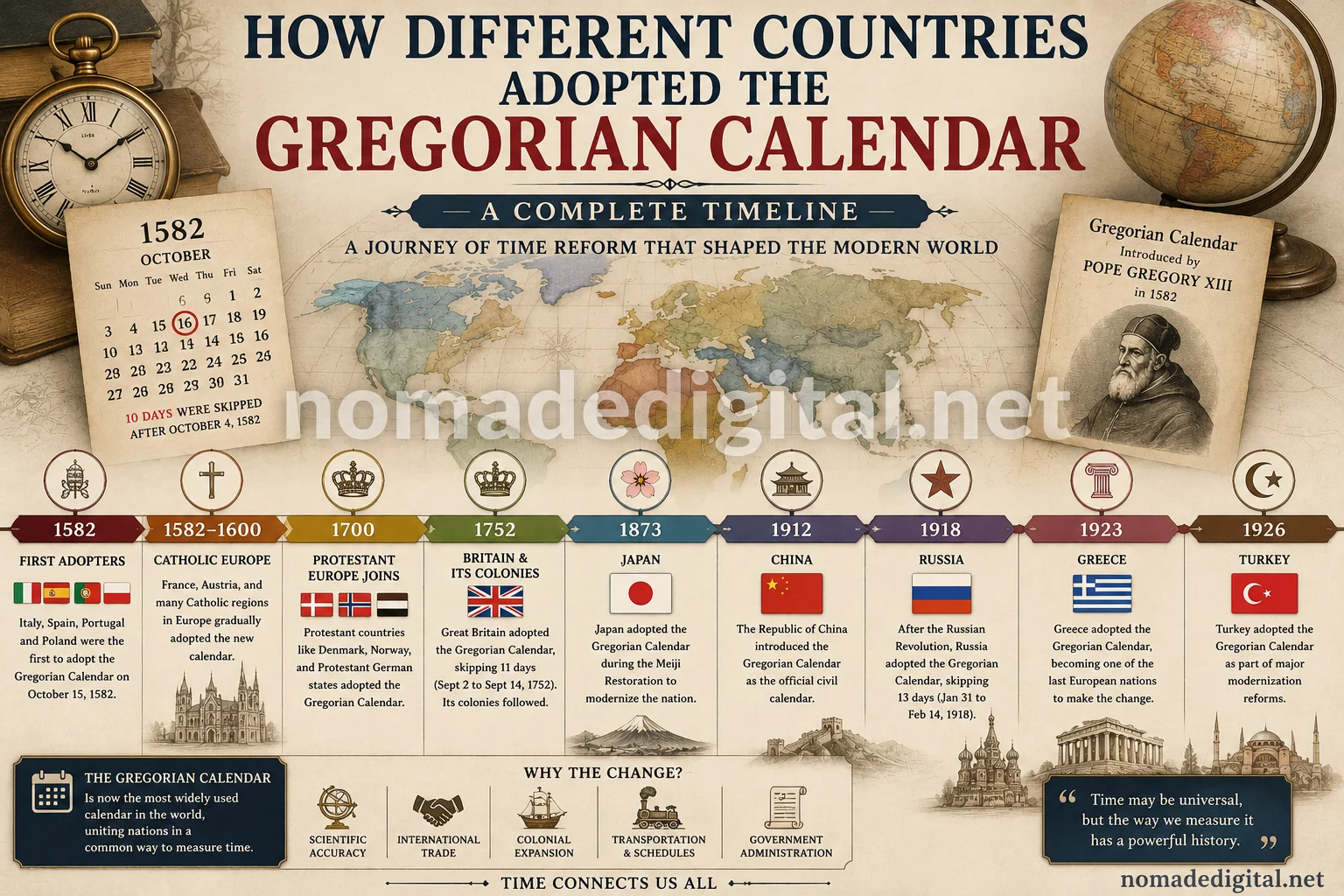
The Gregorian calendar officially took effect on October 15, 1582.
To correct accumulated errors, ten calendar days were removed.
People in adopting countries went to sleep on October 4 and woke up on October 15.
Early Adopters
Catholic nations were the first to accept the reform:
- Italy
- Spain
- Portugal
- Poland
These countries immediately implemented the new calendar under papal authority.
The transition occurred relatively smoothly because of strong ties to the Catholic Church.
1583–1600: Expansion Across Catholic Europe
Following the initial adoption, several Catholic territories joined the reform.
Countries and regions that adopted the Gregorian calendar during this period included:
- France (1582)
- Catholic regions of Germany
- Austria
- The Spanish Netherlands
- Hungary
Religious affiliation played a major role in determining acceptance.
Many Protestant and Orthodox nations remained skeptical of a calendar introduced by the Pope.
Why Protestant Countries Resisted
Protestant nations often viewed the Gregorian calendar as a Catholic innovation.
Political tensions during the Reformation contributed to resistance.
Many rulers feared that adopting the calendar might be interpreted as recognizing papal authority.
As a result, several Protestant countries continued using the Julian calendar for generations.
1700: Protestant Europe Begins Adoption
Scientific evidence and practical concerns eventually encouraged wider acceptance.
By the early eighteenth century, many Protestant regions recognized the advantages of calendar standardization.
Important Adoptions Around 1700
Countries and territories adopting the Gregorian calendar included:
- Protestant German states
- Denmark
- Norway
These nations adjusted their calendars by removing eleven days.
Growing trade and diplomatic relations made synchronization increasingly necessary.
1752: Britain and Its Colonies Adopt the Gregorian Calendar
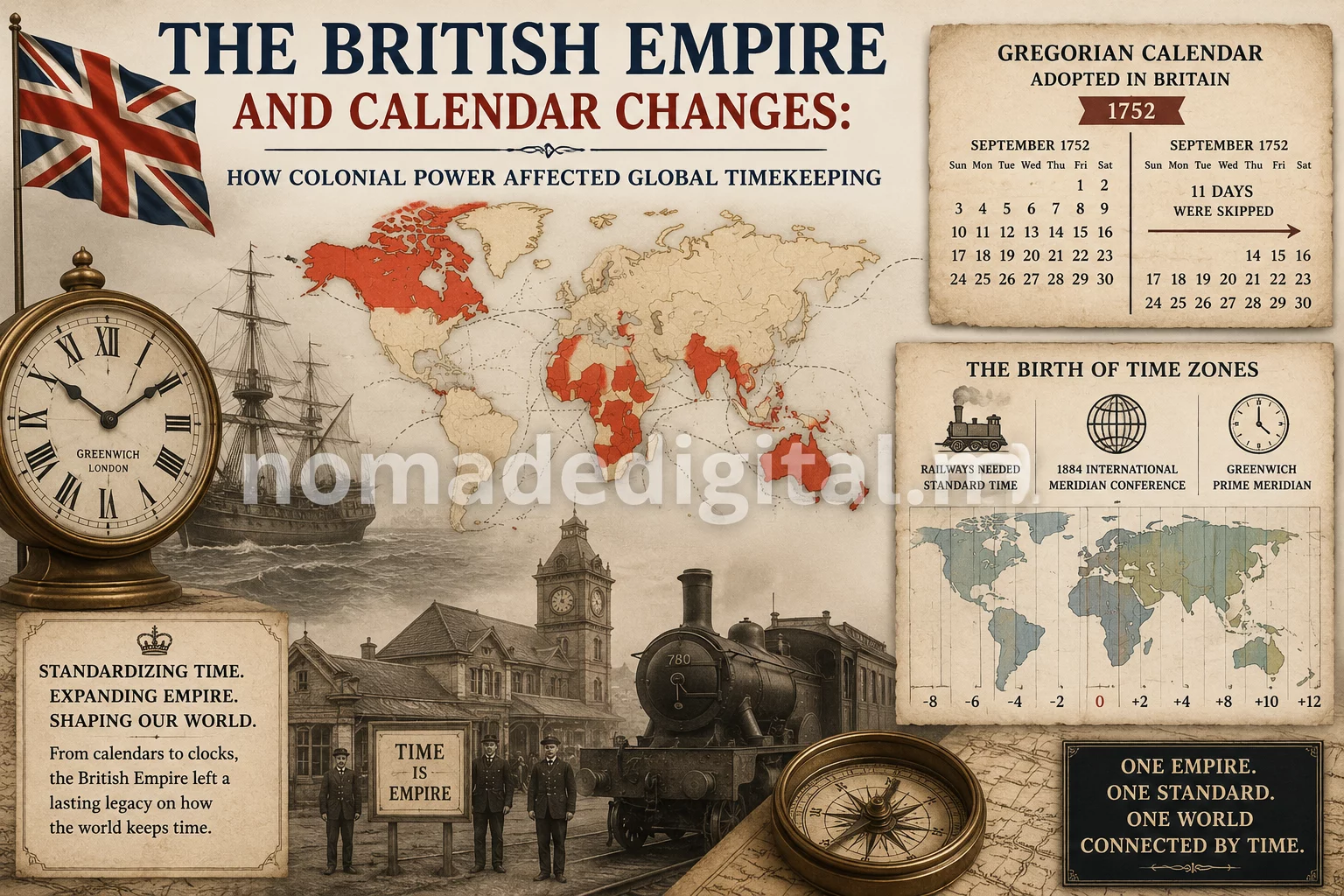
One of the most significant milestones occurred when Britain adopted the Gregorian calendar in 1752.
At the time, Britain controlled numerous colonies across North America and the Caribbean.
The Famous Eleven-Day Adjustment
Britain corrected the discrepancy by skipping eleven days.
September 2, 1752, was followed by September 14, 1752.
British adoption extended to:
- England
- Scotland
- Wales
- Ireland
- American colonies
This decision had a lasting impact on future nations such as the United States, Canada, Australia, and New Zealand.
Calendar Reform in the American Colonies
Because the American colonies were under British control, they adopted the Gregorian calendar simultaneously.
This means that what would later become the United States transitioned to the Gregorian system before gaining independence.
The change improved trade, legal administration, and communication with Europe.
1800s: Global Expansion Through Colonial Influence
The nineteenth century witnessed increased globalization and European imperial expansion.
As colonial powers spread across:
- Africa
- Asia
- Oceania
- The Pacific Islands
the Gregorian calendar increasingly became the standard for government administration.
Even regions maintaining traditional calendars often adopted Gregorian dating for official purposes.
1873: Japan Adopts the Gregorian Calendar
Japan became one of the most important non-Western adopters.
As part of the Meiji Restoration’s modernization efforts, Japan officially adopted the Gregorian calendar in 1873.
The government viewed calendar reform as a step toward modernization and international integration.
Japan continues to use the Gregorian calendar today while also maintaining traditional era-based dating systems.
1912: China Begins Calendar Reform
China’s transition was more gradual.
Following the fall of the Qing Dynasty in 1912, the Republic of China introduced the Gregorian calendar.
However, implementation varied across regions due to political instability.
The calendar became more widely standardized after the establishment of modern governmental structures.
1918: Russia Adopts the Gregorian Calendar
Russia was among the last major European powers to adopt the Gregorian calendar.
After the Russian Revolution, the new Soviet government implemented the change.
The Thirteen-Day Difference
By the twentieth century, the gap between the Julian and Gregorian calendars had grown to thirteen days.
Russia transitioned directly from:
January 31, 1918
to
February 14, 1918
This reform aligned Russia with much of the international community.
Greece: One of Europe’s Final Adopters
Greece officially adopted the Gregorian calendar in 1923.
The country had retained the Julian calendar longer than many neighboring nations due to religious and cultural factors.
Its adoption marked one of the final major transitions within Europe.
Turkey and Modernization Efforts
Turkey adopted the Gregorian calendar in 1926 as part of broader modernization reforms initiated by Mustafa Kemal Atatürk.
The change aimed to strengthen international connections and align Turkey with Western administrative systems.
Countries That Retained Traditional Calendars
Even after adopting Gregorian calendars for civil purposes, many countries preserved traditional systems.
Examples include:
China
Continues to celebrate festivals based on the traditional Chinese lunar calendar.
Islamic Nations
Religious observances often follow the Islamic lunar calendar.
India
Numerous regional and religious calendars remain in use alongside the Gregorian calendar.
Ethiopia
Uses the Ethiopian calendar for many official and religious functions.
These examples demonstrate that calendar adoption often involved coexistence rather than complete replacement.
The Gregorian Calendar Becomes the Global Standard
Several factors contributed to global adoption:
International Trade
Businesses required consistent dating systems.
Scientific Collaboration
Astronomy and research benefited from standardized timekeeping.
Transportation Networks
Railways and shipping relied on synchronized schedules.
Diplomacy
Governments needed common systems for treaties and communication.
Over time, the Gregorian calendar became the default framework for international cooperation.
Timeline Summary of Major Gregorian Calendar Adoptions
1582
- Italy
- Spain
- Portugal
- Poland
1582–1600
- France
- Austria
- Catholic Germany
- Hungary
1700
- Protestant Germany
- Denmark
- Norway
1752
- Britain
- American Colonies
1873
- Japan
1912
- China
1918
- Russia
1923
- Greece
1926
- Turkey
Frequently Asked Questions
Who created the Gregorian calendar?
Pope Gregory XIII introduced the Gregorian calendar in 1582.
Why was the Gregorian calendar created?
It corrected inaccuracies in the Julian calendar and improved alignment with the solar year.
Which countries adopted it first?
Italy, Spain, Portugal, and Poland were among the earliest adopters.
Why did Britain wait until 1752?
Religious and political tensions during the Reformation delayed acceptance.
Why did Russia adopt it so late?
Russia maintained the Julian calendar due to religious traditions and political factors until 1918.
Is the Gregorian calendar used worldwide today?
It serves as the primary civil calendar globally, though many cultures continue using traditional calendars for religious and cultural purposes.
The adoption of the Gregorian calendar was one of history’s most significant timekeeping reforms. What began as a Catholic initiative in 1582 gradually evolved into a global standard embraced by nations across every continent. Religious beliefs, political rivalries, scientific advancements, and colonial expansion all influenced how different countries adopted the Gregorian calendar.
Today, despite the continued use of traditional calendars in many cultures, the Gregorian calendar remains the foundation of international communication, commerce, and daily life. Understanding its adoption timeline offers valuable insight into the interconnected history of science, religion, and global civilization.