Time may seem universal today, but the way the world measures days, months, years, and even hours has been heavily influenced by history. One of the most significant forces behind modern global timekeeping was the British Empire. At its height, the British Empire governed nearly a quarter of the world’s population and controlled territories across every inhabited continent. This vast reach allowed Britain to influence not only politics and economics but also calendars, clocks, and time standards.
The story of how the British Empire affected global timekeeping reveals the powerful relationship between colonialism, administration, trade, and technology. From the adoption of the Gregorian calendar to the creation of standardized time zones, British influence helped shape the systems billions of people rely on today.
The Importance of Calendars in Empire Building
Empires require organization. Governments must collect taxes, schedule transportation, manage trade, coordinate military operations, and communicate across long distances.
Before modern timekeeping systems, many regions followed local calendars and time traditions. Different cultures used various methods to calculate years, religious holidays, and seasonal events. This diversity often created challenges for administration and commerce.
For the British Empire, establishing consistent time standards became essential for governing vast territories spread across multiple continents.
Britain’s Adoption of the Gregorian Calendar
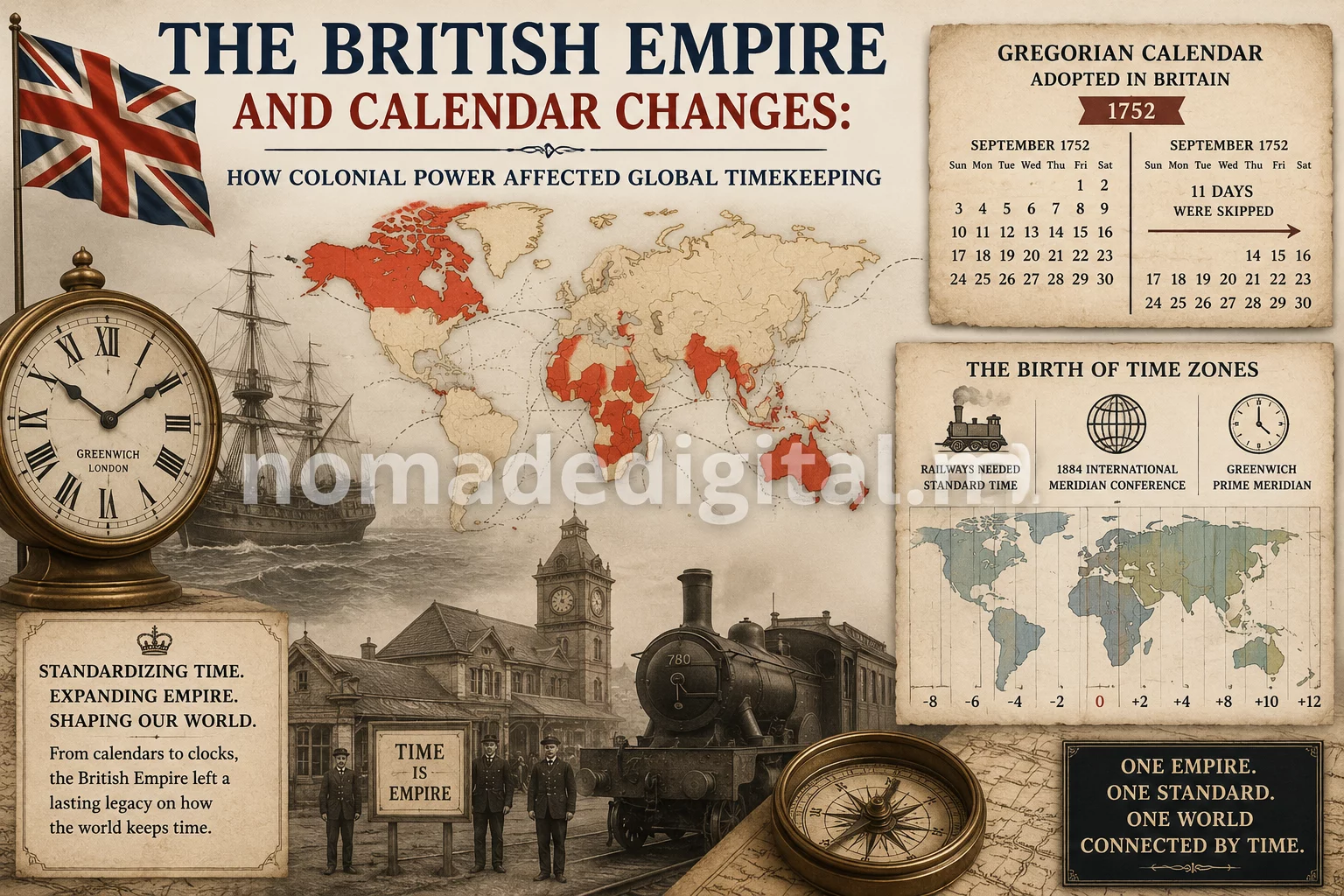
One of the most important calendar changes associated with British influence occurred in 1752 when Britain officially adopted the Gregorian calendar.
The Gregorian calendar had been introduced by the Catholic Church in 1582 to correct inaccuracies in the older Julian calendar. However, Protestant Britain resisted adopting the Catholic-backed calendar for nearly two centuries.
When Britain finally made the switch, eleven days were removed from the calendar. People went to bed on September 2, 1752, and woke up on September 14, 1752.
This calendar reform aligned Britain with many European trading partners and improved consistency in international communication.
Spreading the Gregorian Calendar Through Colonial Rule
As British influence expanded globally, the Gregorian calendar spread throughout colonial territories.
British colonies in:
- North America
- Australia
- New Zealand
- India
- Africa
- The Caribbean
gradually adopted British administrative calendars.
Although local cultural and religious calendars often remained important for festivals and traditions, government operations increasingly relied on the Gregorian system.
This transition helped create a common framework for trade, governance, and legal administration across the empire.
Timekeeping Before Standard Time
Prior to the nineteenth century, most communities used local solar time.
Noon was determined by the position of the sun. As a result, neighboring towns could have slightly different times.
This system worked reasonably well when travel was slow. However, industrialization transformed transportation and communication.
The growth of railways exposed the limitations of local time systems.
Railways and the Need for Standardized Time
The Industrial Revolution dramatically increased the need for precise scheduling.
Train companies required consistent timetables to prevent accidents and improve efficiency.
Britain responded by introducing “Railway Time,” which used Greenwich Mean Time (GMT) as a standard reference.
Railway stations gradually synchronized their clocks with GMT, creating one of the first large-scale standardized time systems.
This innovation laid the foundation for modern timekeeping practices.
Greenwich and the Rise of Global Time Standards
The Royal Observatory in Greenwich, London, became one of the most influential locations in the history of timekeeping.
Greenwich Mean Time served as the reference point for navigation, astronomy, and transportation.
As British maritime power expanded, ships around the world increasingly relied on Greenwich measurements.
By the late nineteenth century, many nations recognized the practical advantages of using Greenwich as the world’s primary reference meridian.
The International Meridian Conference of 1884
A major milestone occurred in 1884 during the International Meridian Conference in Washington, D.C.
Delegates from numerous countries met to establish a global prime meridian.
Greenwich was selected as the international standard.
Several factors influenced this decision:
- British naval dominance
- Extensive global trade networks
- Existing use of Greenwich navigation charts
- International familiarity with British mapping systems
The decision reinforced Britain’s influence on global timekeeping.
The Creation of Modern Time Zones
The adoption of a single prime meridian made standardized time zones possible.
Before time zones existed, coordinating schedules across large distances was extremely difficult.
Time zones divided the world into regions based on longitude, allowing clocks within each zone to display a uniform time.
This system remains the basis of modern global timekeeping.
Many former British colonies integrated these standards into their national infrastructure.
Colonial Administration and Time Discipline
British colonial governments often introduced strict schedules to improve administrative efficiency.
Colonial officials used standardized time for:
- Government offices
- Postal services
- Railway networks
- Military operations
- Educational institutions
Timekeeping became a tool of governance and control.
Historians sometimes describe this process as “time discipline,” where colonial authorities encouraged populations to follow standardized schedules rather than local traditions.
The Impact on India
India provides one of the most significant examples of British influence on timekeeping.
Before colonial standardization, cities often used local solar time.
As railways expanded, maintaining multiple local times became impractical.
The British eventually introduced Indian Standard Time (IST), based on a central meridian.
Today, India continues to use a unified national time system influenced by colonial-era decisions.
Effects on Africa and Other Colonies
Across Africa, British colonial administrations introduced standardized calendars and clocks.
These systems helped coordinate:
- Trade routes
- Resource extraction
- Transportation networks
- Government administration
While many traditional calendars survived for cultural and religious purposes, official operations increasingly followed Western time standards.
This pattern repeated throughout numerous British-controlled territories.
Calendar Systems That Continued Alongside British Influence
Despite the widespread adoption of British administrative calendars, many societies maintained traditional systems.
Examples include:
- The Hindu calendar
- The Islamic calendar
- The Chinese calendar
- Indigenous African calendars
These systems remain important for religious observances and cultural celebrations.
In many countries, multiple calendar systems continue to coexist today.
Lasting Legacy of British Timekeeping
The influence of the British Empire on global timekeeping remains visible every day.
Modern systems rooted in British practices include:
- Greenwich Mean Time (GMT)
- The prime meridian
- International time zones
- Widespread use of the Gregorian calendar
- Standardized transportation schedules
Although the British Empire no longer exists, its impact on how the world measures time continues.
Criticisms of Colonial Timekeeping
Not all historians view these changes positively.
Critics argue that colonial timekeeping systems often displaced local traditions and imposed foreign administrative structures.
Some scholars suggest that controlling time was another way colonial governments exercised authority.
Others emphasize the practical benefits of standardization for communication, transportation, and economic development.
Both perspectives contribute to ongoing discussions about the legacy of empire.
Frequently Asked Questions
Why did Britain adopt the Gregorian calendar?
Britain adopted the Gregorian calendar in 1752 to improve accuracy and align with many European trading partners.
What is Greenwich Mean Time?
Greenwich Mean Time (GMT) is a time standard based on the Royal Observatory in Greenwich, London.
How did railways influence timekeeping?
Railways required consistent schedules, leading to the adoption of standardized time systems.
Why is Greenwich important?
Greenwich became the location of the international prime meridian and served as the foundation for modern time zones.
Did British colonies abandon traditional calendars?
Not entirely. Many regions continued using traditional calendars for cultural and religious purposes while adopting Gregorian calendars for government administration.
Does British influence still affect timekeeping today?
Yes. Modern time zones, the prime meridian, and widespread use of the Gregorian calendar reflect lasting British influence.
The British Empire played a major role in shaping modern global timekeeping. Through calendar reforms, railway expansion, maritime navigation, and colonial administration, Britain helped establish many of the standards that govern time today. The adoption of the Gregorian calendar, the rise of Greenwich Mean Time, and the development of international time zones transformed how societies coordinate activities across vast distances.
While these changes brought efficiency and global consistency, they also reflected the broader influence of colonial power. Understanding the relationship between the British Empire and calendar changes offers valuable insight into how history continues to shape the way we organize and measure time in the modern world.