When most people think about ancient Egypt, they picture pharaohs, pyramids, and hieroglyphs. But one of ancient Egypt’s greatest legacies isn’t buried in the sand—it’s still actively used today. The Coptic calendar, a timekeeping system rooted in the astronomical observations of the pharaonic era, continues to shape daily religious and agricultural life for millions of people across Egypt and Ethiopia. It’s one of those rare examples where something genuinely ancient hasn’t just survived as a museum piece; it’s still running the show for an entire community of believers thousands of years later.
For digital nomads exploring Northeast Africa, historians tracing the roots of Christian liturgical traditions, or developers building culturally inclusive calendar applications, the Coptic calendar is a deeply compelling system. It blends ancient Egyptian astronomy with early Christian theology in a way that no other calendar quite manages to replicate.
The Ancient Egyptian Roots
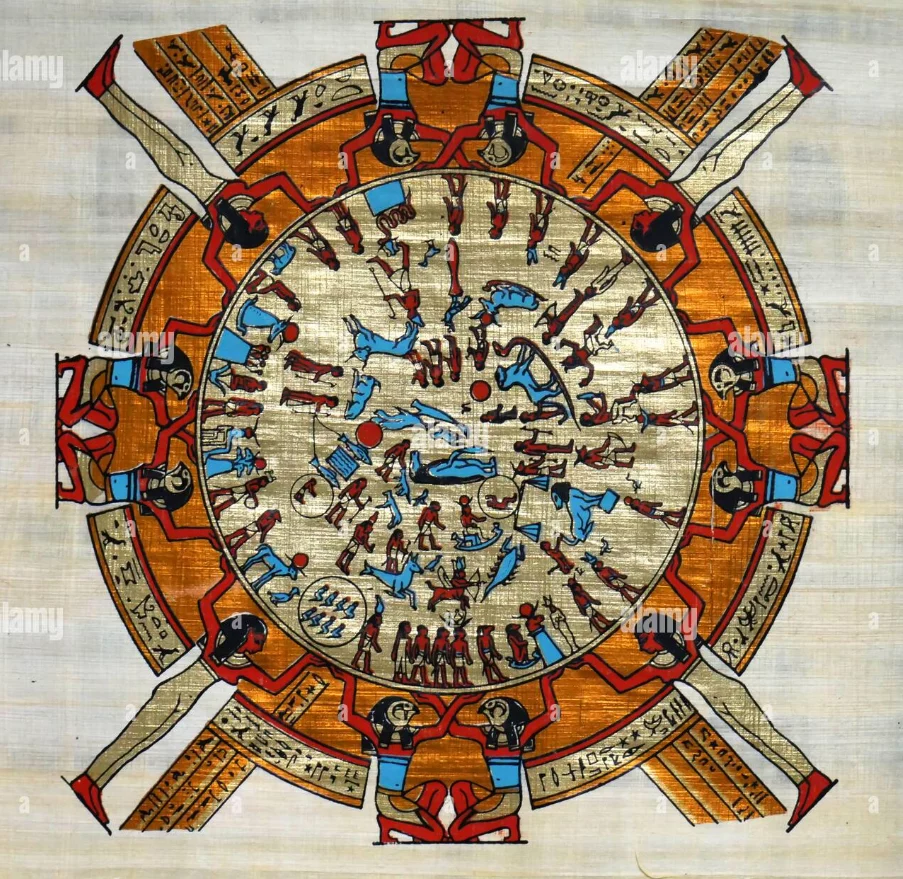
To understand the Coptic calendar, you have to go back much further than Christianity. The calendar’s structure is directly inherited from the ancient Egyptian civil calendar, which was developed somewhere around 4,000 to 5,000 years ago. Ancient Egyptian astronomers noticed that the annual flooding of the Nile—the agricultural event that the entire civilization depended on—coincided with the heliacal rising of the star Sirius (which they called Sopdet). They used this observation to anchor their year.
The ancient Egyptians built a solar calendar consisting of exactly 12 months of 30 days each, totaling 360 days. To fill out the remaining days of the solar year, they added five “epagomenal” days at the end of the year—days considered outside the regular calendar and associated in mythology with the births of major Egyptian gods. This simple but effective 365-day structure became the direct ancestor of both the Coptic calendar we know today and, indirectly, the Julian calendar that Julius Caesar would later introduce to Rome.
From Pharaohs to Christianity: The Transition
The word “Coptic” itself comes from the Greek word Aigyptos (Egypt), which was later adapted into Arabic as Qibt, and eventually became “Copt.” When Christianity arrived in Egypt in the 1st century AD—tradition credits the Apostle and Evangelist Saint Mark with founding the Coptic Orthodox Church in Alexandria around 42 AD—the Egyptian Christians adopted and adapted the existing Egyptian calendar for their liturgical needs.
The most dramatic and defining moment in Coptic calendar history, however, is the Era of the Martyrs, also known as Anno Martyrum (AM). The Coptic calendar counts its years from 284 AD, the year the Roman Emperor Diocletian came to power. His reign saw one of the most brutal persecutions of Christians in the ancient world, and hundreds of thousands of Egyptian Christians were killed for their faith. Rather than adopting the Roman year-counting system, the Coptic Church chose to honor its martyrs by anchoring its entire calendar to this period. This is why the Coptic year is often referred to as the Year of the Martyrs.
The Structure of the Coptic Calendar
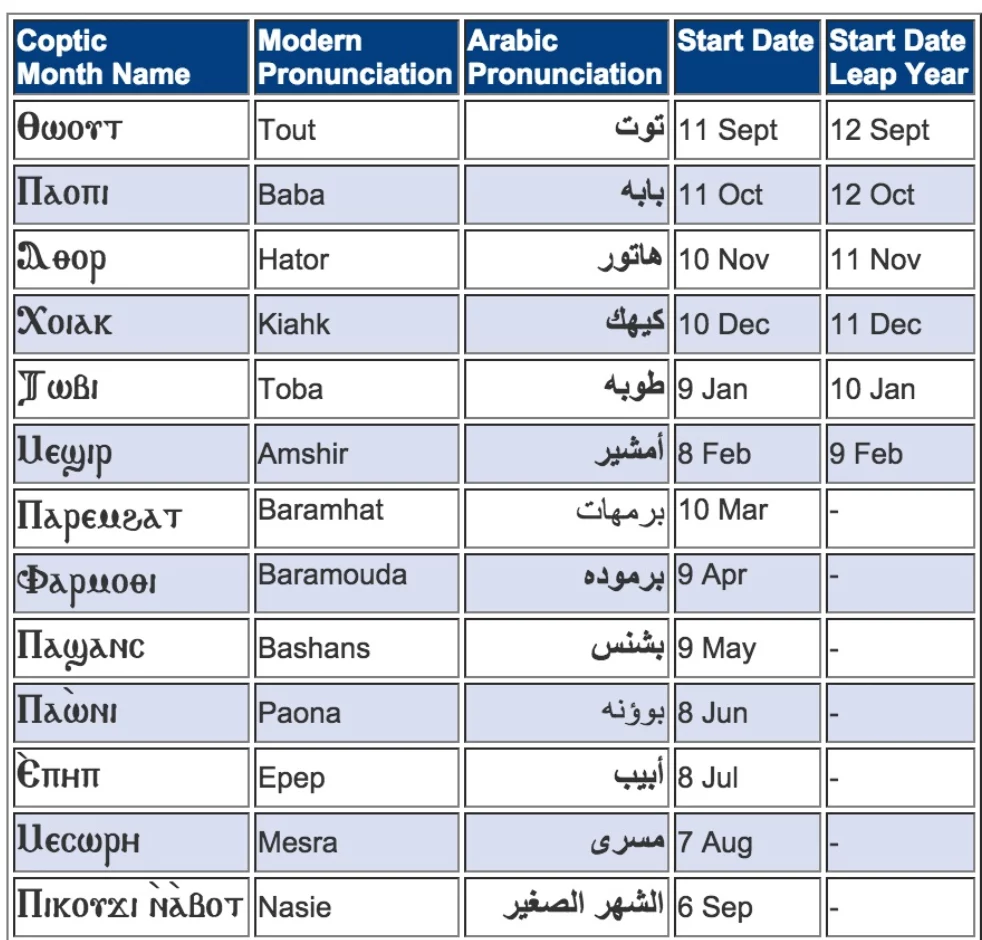
The Coptic calendar maintains the elegant simplicity of its ancient Egyptian ancestor while adding a critical astronomical adjustment. The year is divided into 13 months. The first 12 months each have exactly 30 days. The 13th month, called Nasie (or Pi Kogi Enavot in Coptic), has just 5 days in a common year and 6 days in a leap year.
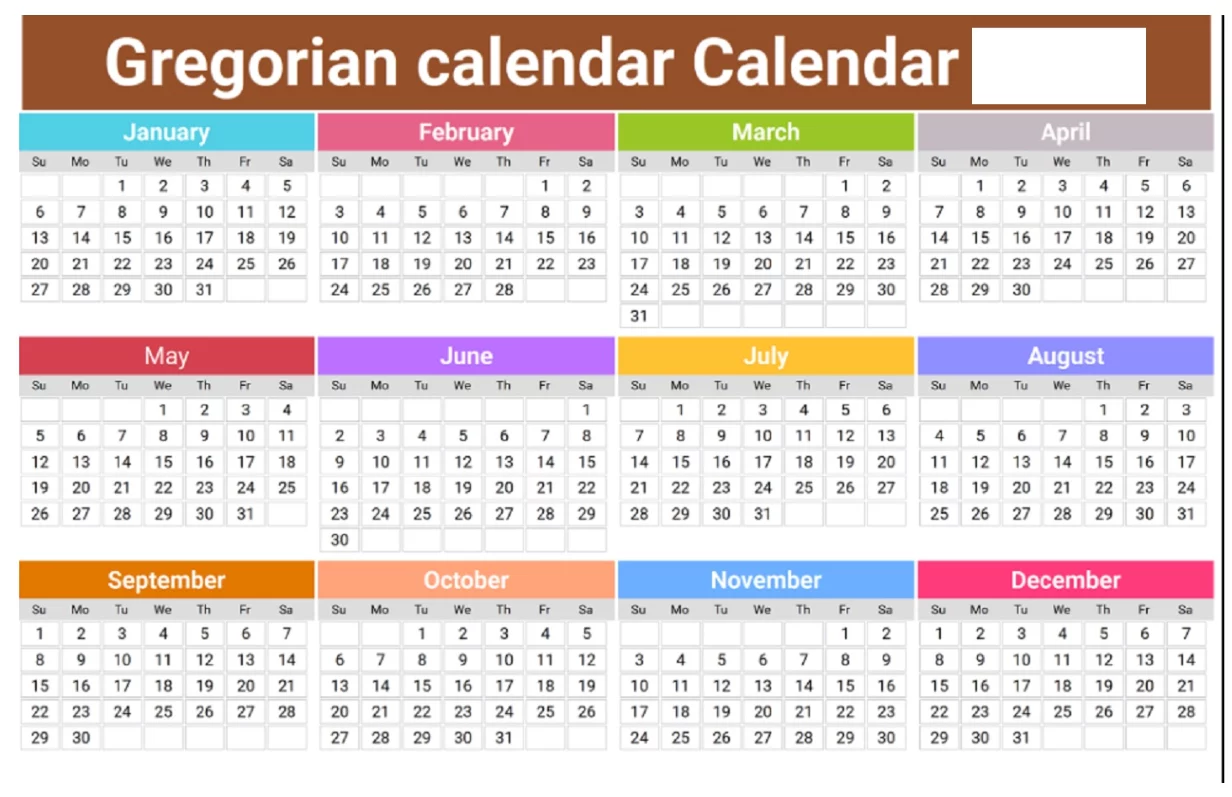
This 13-month structure gives the Coptic calendar exactly 365 days in a common year and 366 days in a leap year. Unlike the Gregorian calendar’s more complex leap year rules, the Coptic calendar follows the simpler Julian rule: every fourth year is a leap year, without exception. This means the Coptic leap year always occurs in the year preceding a Gregorian leap year. For example, 2023 in the Gregorian calendar was a Coptic leap year because 2024 (its Gregorian counterpart) was a Gregorian leap year.
The 13 months of the Coptic calendar are: Thout, Paopi, Hathor, Koiak, Tobi, Meshir, Paremhat, Paremoude, Pashons, Paoni, Epip, Mesori, and Nasie. Each of these names traces directly back to ancient Egyptian month names, many of which are themselves derived from Egyptian gods and festivals.
The Coptic Calendar in Modern Egypt and Ethiopia
Today, the Coptic calendar plays two distinct but equally important roles in modern Northeast Africa. In Egypt, it is primarily a liturgical calendar used by the Coptic Orthodox Church—one of the oldest Christian churches in the world, with an estimated 10 to 15 million members in Egypt alone. Every Coptic religious feast, fasting period, and saint’s day is scheduled according to the Coptic calendar. Christmas, for instance, is celebrated by Coptic Christians on what corresponds to January 7th on the Gregorian calendar (29 Kiahk in the Coptic system).
In Ethiopia, the story is slightly different and even more widespread. The Ethiopian Orthodox Church uses the Ethiopian calendar, which is essentially the Coptic calendar with slightly different month names and a different year count based on a different calculation of the year of Christ’s birth. The Ethiopian calendar runs approximately 7 to 8 years behind the Gregorian calendar—meaning that when the rest of the world celebrated the year 2000, Ethiopia rang in the year 1992. Ethiopian New Year, known as Enkutatash, falls in September and is one of the most joyous national celebrations in the country.
Agricultural Significance That Hasn’t Faded
Beyond its religious function, the Coptic calendar retains a surprisingly strong role in Egyptian agriculture. Because the calendar is anchored to the solar year and closely tracks the seasonal cycle of the Nile region, rural Egyptian farmers—particularly in Upper Egypt—still reference Coptic dates for planting and harvesting schedules. Specific Coptic dates are traditionally associated with the onset of seasonal winds, temperature shifts, and optimal farming conditions that have been observed and recorded for thousands of years.
This agricultural dimension gives the Coptic calendar a practical, everyday relevance that goes well beyond church walls. It’s a living piece of infrastructure for communities that have relied on the rhythms it tracks since long before the Christian era.
Building Coptic Calendar Support in Modern Apps
For developers working on globally inclusive software, supporting the Coptic calendar is increasingly relevant. Whether you’re building a religious scheduling app for Coptic communities or a travel platform that highlights cultural events in Egypt and Ethiopia, proper date conversion is essential. Libraries like ICU (International Components for Unicode) include Coptic calendar support, and Python’s convertdate library handles Coptic date conversions cleanly.
The main algorithmic challenge is the year offset and correctly mapping the 13-month structure onto standard Gregorian date representations, particularly around the short 13th month of Nasie. Get that right, and the rest of the conversion logic is surprisingly straightforward thanks to the calendar’s simple leap year rule.
Why the Coptic Calendar Deserves More Attention
In a world obsessed with the latest technology and the newest systems, there is something genuinely humbling about a calendar that has been running continuously for over 5,000 years. The Coptic calendar is not a relic—it is a living tradition, faithfully maintained by millions of Christians across Northeast Africa and diaspora communities around the world. It connects its users to the ancient Nile, to the early Christian martyrs, and to a system of astronomical observation that predates most of human recorded history.
For anyone exploring the rich tapestry of global timekeeping, the Coptic calendar stands as one of the most remarkable examples of cultural continuity on the planet.